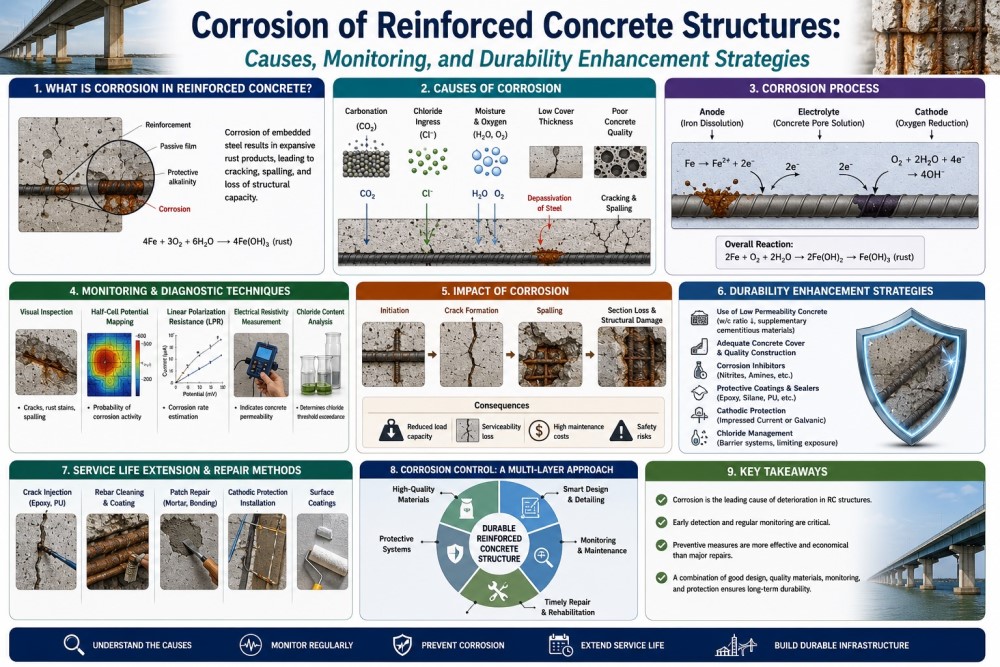
Corrosion of steel reinforcement in concrete structures is one of the most critical durability challenges facing global infrastructure, with annual economic losses estimated at approximately US$2.5 trillion, accounting for 3.4% of global GDP . This comprehensive review systematically examines the causes, monitoring technologies, and durability enhancement strategies for reinforcement corrosion in concrete structures. The electrochemical mechanism of corrosion involves anodic dissolution of iron (Fe → Fe²⁺ + 2e⁻) coupled with cathodic oxygen reduction (O₂ + 2H₂O + 4e⁻ → 4OH⁻), with rust formation and its 2-6× volumetric expansion relative to steel inducing tensile stresses exceeding concrete's tensile strength . Two primary depassivation mechanisms govern corrosion initiation: chloride-induced pitting corrosion, where chloride ions disrupt the passive γ-Fe₂O₃ layer, and carbonation-driven pH reduction compromising protective film stability . Monitoring technologies have evolved from conventional half-cell potential and linear polarization resistance methods to advanced techniques including electrochemical impedance spectroscopy (EIS), distributed fiber optic sensing, and AI-driven predictive models achieving >98% detection accuracy . Mitigation strategies encompass electrochemical methods (cathodic protection, chloride extraction, realkalization), corrosion inhibitors with demonstrated ~45% weight loss reduction, and emerging polymer-modified concretes reducing chloride penetration by 30-50% while extending service life by 2-3 times . The review concludes that effective corrosion management requires integrated approaches combining mechanistic understanding, advanced monitoring, and sustainable material solutions.
Zbuzant, M. (2026). Corrosion of Reinforced Concrete Structures: Causes, Monitoring, and Durability Enhancement Strategies. Journal of Chemical Engineering and Energy Materials, 2(3), 220-233. https://doi.org/10.5281/zenodo.21792561
MLA
Zbuzant, M. "Corrosion of Reinforced Concrete Structures: Causes, Monitoring, and Durability Enhancement Strategies", Journal of Chemical Engineering and Energy Materials, 2, 3, 2026, 220-233. doi: 10.5281/zenodo.21792561
HARVARD
Zbuzant M. (2026). 'Corrosion of Reinforced Concrete Structures: Causes, Monitoring, and Durability Enhancement Strategies', Journal of Chemical Engineering and Energy Materials, 2(3), pp. 220-233. doi: 10.5281/zenodo.21792561
CHICAGO
M. Zbuzant, "Corrosion of Reinforced Concrete Structures: Causes, Monitoring, and Durability Enhancement Strategies," Journal of Chemical Engineering and Energy Materials, 2 3 (2026): 220-233, doi: 10.5281/zenodo.21792561
VANCOUVER
Zbuzant M. Corrosion of Reinforced Concrete Structures: Causes, Monitoring, and Durability Enhancement Strategies. Journal of Chemical Engineering and Energy Materials. 2026;2(3):220-233. doi: 10.5281/zenodo.21792561