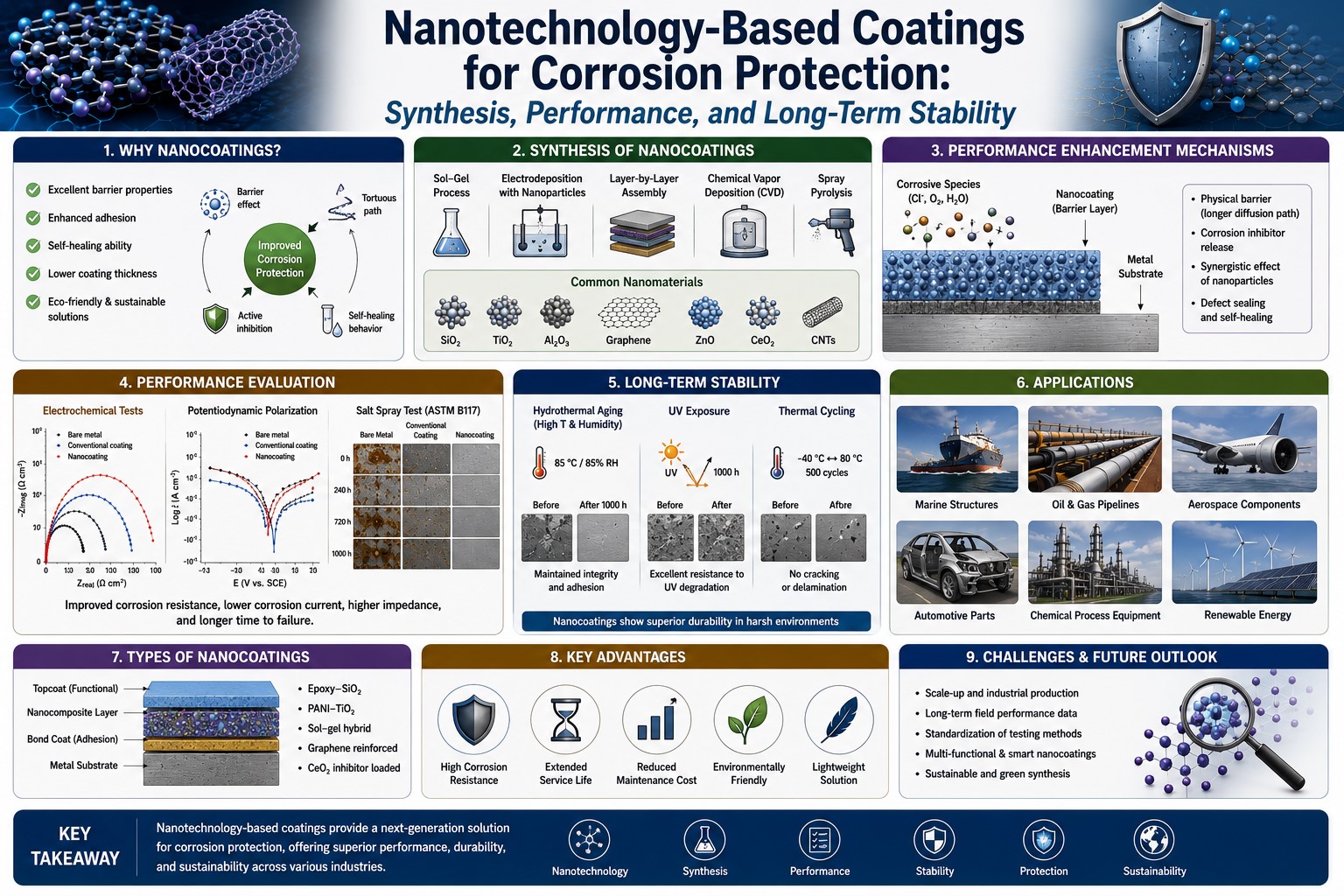
Nanotechnology-based coatings have emerged as transformative solutions for corrosion protection, addressing the fundamental limitations of conventional barrier coatings through multifunctional design and active protection mechanisms. This comprehensive review systematically examines the synthesis, performance, and long-term stability of advanced nanocomposite coatings for corrosion protection. Key material systems include intrinsically conductive polymers, 2D nanomaterials (graphene, graphene oxide), inorganic nanoparticles (CeO₂, SiO₂, TiO₂, ZnO), and stimuli-responsive nanocontainers. Electrochemical impedance spectroscopy (EIS) results demonstrate that H-CeO₂@GO/epoxy composite coatings maintain high impedance values of 10^9.45 Ω·cm² after 60 days of immersion in 3.5 wt% NaCl solution, while HQZn-PA nanocomposite coatings achieve an impedance modulus of 1.03 × 10^10 Ω·cm² after 40 days with a self-healing efficiency of 99.28% . Self-healing coatings incorporating corrosion inhibitor-loaded nanocontainers enable autonomous repair of coating damage through coordination-controlled release mechanisms triggered by pH, ions, or redox potential changes . Graphene-based coatings provide exceptional barrier properties through their 2D lamellar structure, with incorporation of 5 wt% graphene reducing corrosion rates from 3.4 × 10⁻² to 5.0 × 10⁻⁵ mmpy . Challenges persist in long-term stability under harsh service conditions, dispersion uniformity, scalability, and environmental sustainability.
Zbuzant, M. (2026). Nanotechnology-Based Coatings for Corrosion Protection: Synthesis, Performance, and Long-Term Stability. Journal of Chemical Engineering and Energy Materials, 2(3), 234-248. https://doi.org/10.5281/zenodo.21792727
MLA
Zbuzant, M. "Nanotechnology-Based Coatings for Corrosion Protection: Synthesis, Performance, and Long-Term Stability", Journal of Chemical Engineering and Energy Materials, 2, 3, 2026, 234-248. doi: 10.5281/zenodo.21792727
HARVARD
Zbuzant M. (2026). 'Nanotechnology-Based Coatings for Corrosion Protection: Synthesis, Performance, and Long-Term Stability', Journal of Chemical Engineering and Energy Materials, 2(3), pp. 234-248. doi: 10.5281/zenodo.21792727
CHICAGO
M. Zbuzant, "Nanotechnology-Based Coatings for Corrosion Protection: Synthesis, Performance, and Long-Term Stability," Journal of Chemical Engineering and Energy Materials, 2 3 (2026): 234-248, doi: 10.5281/zenodo.21792727
VANCOUVER
Zbuzant M. Nanotechnology-Based Coatings for Corrosion Protection: Synthesis, Performance, and Long-Term Stability. Journal of Chemical Engineering and Energy Materials. 2026;2(3):234-248. doi: 10.5281/zenodo.21792727